Al-Amlaq City for People with Special Needsمدينة العملاق لذوي الاحتياجات الخاصة

A specialised institution providing medical, educational and vocational services to raise a person’s independence and their integration into society — across 51,000 m², with part of its running costs met by a specialised medical centre serving the whole region.

Berber Locality, River Nile State, Sudan

See the evidencePartner with us

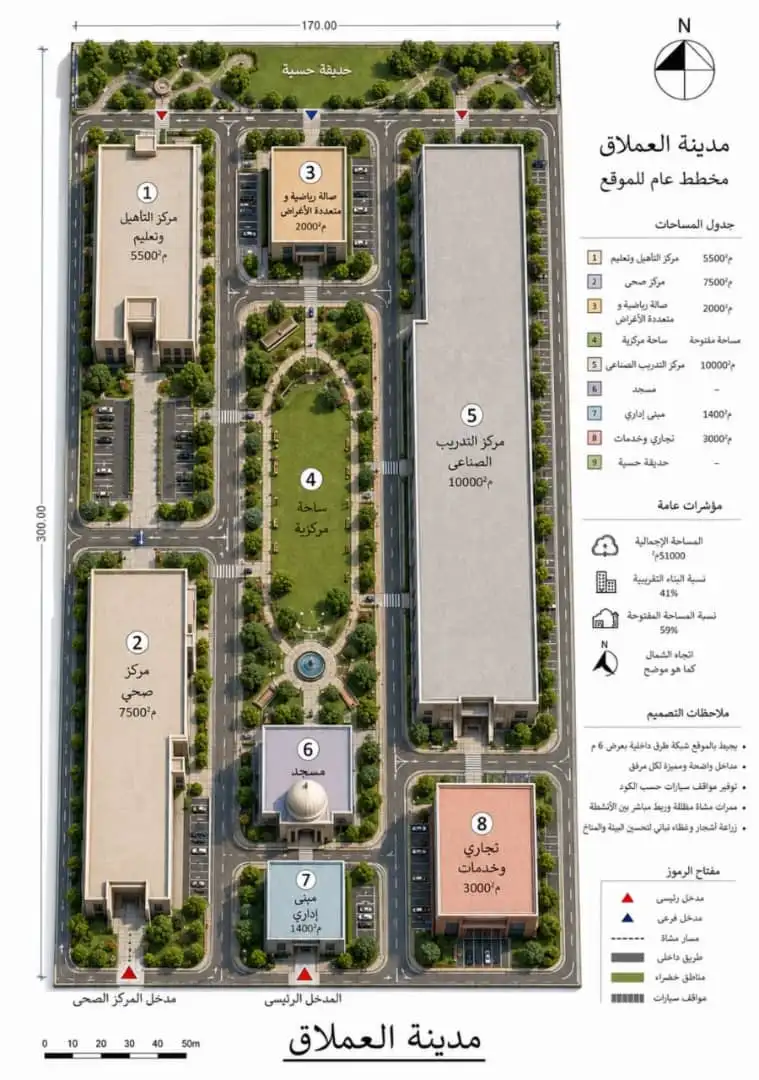
The master site plan of Al-Amlaq City: nine numbered facilities arranged across a rectangular plot around a landscaped central plaza.

Three figures, each with its source

Only what can be traced. Select any figure to reach the analysis behind it.

51,000

Site area

Source: Master site plan

9

Facilities on the plan

Source: Master site plan

26,516 – 58,490

People with special needs in Berber Locality

Planning estimates, not a register of identified individuals.

Source: Project statistical analysis, applying 6.8% and 15%

Where to start

This site serves three readerships at once. Take the route closest to yours.

  • For funders and partners

    The evidence first

    A statistical analysis with its external sources named, a need ranging from 26,516 to 58,490 people in the locality alone, and a sustainability model that answers "what happens when the grant ends?"

  • For our community and diaspora

    Fifteen years in the making

    The idea was put to local officials in 2010 and dismissed. It did not go away. Here is the story, the approved plan, and ways to contribute that do not involve money.

  • For government and institutional partners

    Locality-level data

    Detailed estimates for Berber Locality and River Nile State, the reduced burden of travelling for treatment, job creation, and readiness to operate within existing ministry frameworks.

The problem

In Berber Locality alone, the number of people with special needs is estimated at between 26,516 and 58,490. Close to half the locality is under 18, and more than two thirds of people with special needs in Sudan live outside towns.

The 2022 Afrobarometer survey in Sudan found that 82% of respondents rated government performance in protecting and caring for children and vulnerable groups as poor or very poor, and that social service centres were within close reach in only around 32% of surveyed areas.

That some kind of help exists is not a system. A system means diagnosis, physiotherapy, speech therapy, audiology, vision services, assistive devices, autism assessment, special education, vocational rehabilitation and family support — connected to each other, not scattered.
Sources: Afrobarometer, Sudan 2022; and the project statistical analysis drawing on UNFPA / UN OCHA 2025 population data and the Sudan 2008 census.

The answer

Not a concept — a drawn scheme. Nine facilities on a plot of 170 × 300 metres, 41% built and 59% left open.

Schedule of areas, as given on the master site plan
#FacilityAreaWhere it sits on the plan
1Rehabilitation & Education Centre5,500 m²The north-west corner of the site, with a large parking court on its east side.
2Health / Medical Centre7,500 m²The south-west block, with its own entrance on the south side that keeps clinical traffic separate from the general campus entrance.
3Sports & Multi-purpose Hall2,000 m²North of the site, between the rehabilitation centre and the sensory garden.
4Central PlazaOpen areaThe heart of the site: a landscaped spine with lawn, tree-lined walks and a fountain, linking every activity to the others.
5Industrial Training Centre10,000 m²The east strip, running nearly the full north–south depth of the site — the largest single building, placed deliberately away from the clinical and educational cores.
6MosqueNot given on the planSouth of the site on the axis of the central plaza, with a dome.
7Administration Building1,400 m²South of the mosque, near the main entrance.
8Commercial & Services3,000 m²The south-east corner.
9Sensory GardenNot given on the planThe north edge, running the full width of the site as a landscaped buffer strip.

Source: the master site plan. Facilities the plan gives no area for appear here as they are, without an estimate filled in.

How it sustains itself

This is the least-told part of the project and the part a funder most needs to hear.

The specialised medical centre inside the city is not only a clinical department — it is the economic engine. It provides paid services to the wider community — specialist clinics, physiotherapy, inpatient admission, minor surgery, radiology and laboratories, rehabilitation — and a defined share of that revenue funds free and low-cost care for people with special needs.

The project states its philosophy as "Therapeutic Service + Humanitarian Sustainability": healthcare that is neither purely for profit nor a charity wholly dependent on donations. It includes a treatment support fund, free care for the most needy cases, discounts for low-income families and therapy sessions at nominal prices — all administered through a social assessment system designed for fairness and transparency.

That is the answer to "what happens when the grant ends?"